ENTRIES START
Below you can find links to the various (natural & artificial) groups of Icelandic plant species. From there you can identify single species and find the information on that species.
 Club mosses and ferns: Horsetails and True Ferns
Clubmosses and ferns consist of 3 basic groups:
1)
clubmosses:
these are plants with small leaves, having only one vein. The leaves are more or less pressed onto the stem.
2)
horsetails:
these are plants with leafless stems. Some only have one main stem where others have side branches, but never leaves.
Spore forming organs are conically placed on the top of the
stems. This group is regarded as a fern-ally
3) true ferns
(leafy plants, leaves (fronds) are usually divided in leaflets. Stems very
short usually not visible. The spore forming organs (sporangia) are often on the bottom
side of the leaves. Some ferns though have the sporangia in other places.
Below are the links to information on specific clubmoss species
Next the links to information on specific horsetail species. Note that some species sometimes lack side branches but not always. The division below is merely a quick introduction. On the pages of the individual species this is clarified.
(1) Horsetail species usually with branched stems. These branches are placed in whorls around the main stem
(2) Horsetail species usually lacking side branches from the main stem
Note that E. palustre (marsh horsetail) is in both series; that is because at first it may seem to be without lateral branches but later on during the season it clearly does have lateral branches.
And now the links to information on specific true fern species. Note that the first series contains a natural group, the second and third does not reflect natural groups.
1): Ophioglossids: members of the Ophioglossacea (Adder's-tongue family). Members of this family have one leaf that is divided into a vegetative green part (blade) and a generative part that holds the sporangia. Note that this section is far from complete.
2): Single leaves not disected in leaflets or compound leaves having only first order leaflets (meaning the leaves are disected only once in a row - these first order leaflets are not disected any further - pinnate leaves)
3): leaves disected at least twice in a row (bipinnate leaves)
Woody Species: Gymnospermae
Note: only the Juniper is indigenous to Iceland. The other 3 species are introduced trees. Apart from these 3 species many other pine-related species have been introduced for forestation projects.
Woody species: Birches, Willows & miscellaneaous (Angiosperm) trees.
Woody species excluding willows:
Willow species:
Heather family: heathers, related berry species and wintergreen species
Heath species (1): Crowberry (Empetrum), Common heather (Calluna) and other heather species species:
Heather species (2): Arctostaphylos (bearberry) and Vaccinium species:
Wintergreen species: (Note: the Pyrola and Orthillia species {wintergreen's} have been regarded as members of their own family - Pyrolaceae. Recent genetic studies lead specialists to conclude that they have to be included in the Ericaceae = heather family).
Herbs, flowers have free petals (1): Dock, Goosefoot, Purslane, Sundew and Nettle family species
The choripetalae are large group of herbs. In this section three related families are treated: the dock/sorrel, the goosefoot and the purslane family.
Dock / Sorrel family:(Polygonaceae): Rather small reddish or white flowers clustered in dense inflorescenses.
Goosefoot, Purslane, Sundew and Nettle families:
Goosefoot family (Chenopodiaceae): On Iceland there is just one common species. It is a coastal plant often growing on sandy beach soils over flood deposits. Small inconspicuous green or reddish flowers grouped together.
Purslane family (Portulacaceae): Also one common species on Iceland: Montia fontana (Blinks). Note there is also a plant called Iceland-purslane. Contrary to what the name suggests, this is not a member of the purslane family but it belongs to the dock family (see above).
Nettle family (Urticaceae): The nettle family is represented by two introduced weedy species. They are regarded as "aliens".
Herbs, flowers with free petals (2): Saxifrage & Stonecrop family
Saxifrage family (Saxifragaceae): Starry flowers usually (creamy-)white but two species are yellow and one purple. The calyx is often fused at the bottom. For identification the family is split in three series: being the non-white flowering members of the Saxifraga genus plus the white flowering "Grass of Parnassus" (Parnassia palustris). The latter is member of the Saxifraga family but not a true Saxifraga, The second and third list present the white flowering Saxifraga's. It is easy to change the lists within any page though.
Now we explore the Stonecrop family (Crassulaceae) in this section. On Iceland only a few stonecrop species are common in the wild. Typically the members of this family have fleshy leaves. It includes three stonecrops (Sedum) species and the rose root (Rhodiola rosea)
These are:
Herbs, flowers with free petals (3): Rose, Buttercup & Poppy family
Now let's go to the Rose family (Rosaceae).
It is very difficult - if not impossible - to name a single feature for identifying a plant as a member of the rose family. Common species on Iceland are lady's-mantle's, Cinquefoils and Mountain&Water Avens. In order to keep some order I heve split them in three groups being:
1) the Alchemilla species (Lady's mantles)
2) the Potentils and relatives (Comarum and Sibaldia)
3) the remaining species
Whithin a specific species data page one can switch these lists
The next family listed below is the Buttercup and Poppy family. Most of them have yellow flowers, some though have white flowers. Some are (semi-)aquatic plants. Buttercups on Iceland are usually yellow-flowered or white (be aware of cinquefoils of the Rose family with superficially similar flowers). A common but rather strange little plant is the alpine meadow-rue which has one row of small purple flower leaves. The link start with the alpine meadow-rue from where one can easily find and identify other buttercups. The poppy family is also included here.
In order to keep it apprehensible I have split this group into three different lists, being:
1) The Yellow-flowered Buttercup family species
2) The White-flowering Buttercup family species
3) Poppies
1) Yellow-flowered species of the buttercup family (Ranunculaceae)
2) Non yellow-flowered species of the buttercup family (Ranunculaceae)
3) Species of the poppy family (Papaveraceae)
Herbs, flowers have free petals (4): the Willowherb family, the Carrot/Parsley & Ivy families and the Pea family
This section introduces the Willowherb family, the Umbel (Carrot/Parsley) & Ivy families and the Pea family. They are grouped in the following links:
Willowherb family (Onagraceae): a family of mainly bluish/purplish flowers. Typically willowherbs have flowers placed on top of a long stretched immature fruit. The fruits generally have more or less the same colour as the flowers (purplish). All more or less common species of this family consist of members of the Chamerion genus and the Epilobium species.
Carrot family (Apiaceae formerly known as Umbelliferae): Typically for this family is the combination of compound leaves and umbel shaped inflorescense's, hence the (deprecated/old) family name Umbelliferae.
The Marsh Pennywort was until recently regarded as a member of the parsley family (
Apiaceae) but is now a member of the Ivy family (
Araliaceae).
Pea family (Fabaceae also known as Papillionaceae): The members of the Pea family have a unique flower structure and fruits (pod fruits). The flower petals consists of a usually large top petal two side petals and a boat shaped bottom petal in which lies a column of the stamens and pistil with the early pod fruit.
Herbs, flowers have free petals (5): Mustard family
Members of the mustard family - known both as Cruciferae and Brassicaceae - are pure herbaceas plants. Many vegetables belong to this group: cabbages, radish, etc. On Iceland many species of the wild are small and white flowering plants. Because there are also many white-flowering members of the pink family on Iceland - here is the simple way to distinguish them: pink family species always have opposite leaves along their stems, members of the mustard family never have opposite leaves along their stems.
The Draba genus with white flowers is common with a few species. Next to other white-flowering species there are also a few non-white flowering species.
Mustard family species 1: non-white flowering species
Mustard family species 2: white/yellow flowering species belonging to the Draba genus
Mustard family species 3: All other white flowering species
Herbs, flowers have free petals (6): Pink family
Because the number of Pink species on Iceland is rather large, I have split the group in four series.
The first series includes the Chickweeds/Stitchwort group and Spurrey
The second series includes the Cerastium and Arenaria species (Mouse-ear and Sandworts):
The third series includes the Sagina species (Pearlwort species) and Minuartia(sandwort):
The fourth series includes the Lychnis (catchfly), Silene (campions) and Honckenya (Sea sandwort) species:
Herbs, flowers have free petals (7): Plantain family & related families (mare's tail, water-starworts and speedwell's)
First the three Plantain species
Second: related species (Hippuris and Callitriche species)
Third: related species (Veronica species)
Herbs, flowers have free petals (8): Violets and miscellaneous other species with free petals
On Iceland four violet species are common. On the page of the Alpine Marsh Violet (V. palustris) the differences between the species are described. The link to this species is here.
In this section we wrap up the remaining species with flowers having free petals. The species here are only distantly related.
Flowers with fused petals 1: Gentian family
Gentians (family: Gentianaceae) are typically summer-flowering plants.
Flowers with fused petals 2: Broomrape, Mint and Lopseed (monkey flower) families
These species are semi-parasites: they tap their own root system into the roots of other plants in order to acquire (steal) nutrients from these other plants (often grasses). They have flowers with a left/right symmetry.
The number of mint species growing in the wild on Iceland is small. Actually only thyme and selfheal are considered indigenous. The two "nettles" are introduced weeds and the water mint is rare introduced species only growing only on a few thermal soils. The low number of species reflects the fact that the members of the mint family are generally warmth-loving species. Having said this though it should be noted that the arctic thyme (a subspecies of the wild thyme) is very common all over Iceland where plant-growth conditions are not extremely tough. Members of this family also have flowers with a left/right symmetry.
This is an introduced species (from America) growing in shallow creeks.
Flowers with fused petals 3: Daisy family
The daisy family (Asteraceae) is a very large family. Characteristic for this family is that (very) many single flowers are grouped together in a flowerhead which in turn resembles one single flower. This is accentuated by the fact that often the outer ring of the flowers on the head have one long petiole (ligulate or ray flowers). The ring of these single ray flowers on the outer edge of the flowerhead make the head appear to be just one flower (think of the sunflower). This is not always the case! There are daisies with only ray flowers (like dandelion) and there are those without ray flowers at all (example: Pineaple weed / Tansy).
Flowers with fused petals 4: All others
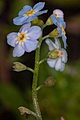
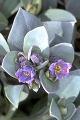
Bellflowers, Forget-me-not's and Oysterplant (Campanulaceae and Boraginaceae families):
Bedstraw (Galium) species (Rubiaceae family).
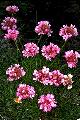
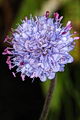
Follows the remaining herbs with fused petals: Thrift, Common Butterwort, Valerian and Devil's-bit Scabious species.
Sealavender family (Plumbaginaceae), Bladderwort family (Lentibulariaceae) and Honeysuckle family (Caprifoliaceae)
Monocotyledons: Lily groups including rushes
Lily family and closely related to the lily family members.
The number of species growing in the wild on Iceland of this group is very limited. Very common is the Scottish asphodel (Tofieldia pusilla). Quite common are Arrowgrasses (Marsh and Sea arrowgrasses). The Herb Paris (Paris quadrifolia) is more rare. It can be found in lava crevasses.
Rushes: Due to their leaf-forms, rushes appear at first glance to be something like grasses or sedges. Close inspection on flowers show they have - be it small - neat 6 floral leaves like lily flowers - very different to the complex spike(lets) inflorescences of sedges and grasses.
First: the Luzula rushes (known as Wood-rushes): wood-rushes have hairy grass blade-like leaves
Second: the Juncus rushes
The Juncus rushes have hollow-pointed leaves (more or less like chives)
For conveniance I have split them in three groups: the taller species (20cm+), the middel-sized species (10 à 15 cm) and the smaller (low) species (rarely taller than 5 cm).
Taller species: over 30cm (usually 40cm+).
Middle-sized species: 10 to 20 cm tall - (rarely up to 30cm)
Smaller (low) species (rarely over 5cm. tall ; occasionally up to 25cm.)
Monocotyledons: Orchids
Orchids:
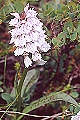
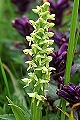
Although the number of common species is relatively low, orchids are common throughout the better vegetated regions of Iceland. Below are listed all more or less common orchid species of Iceland (just open any species and this list will appear).
Monocotyledons: Sedges
The sedge family (Cyperaceae) is well represented in the Icelandic flora. The major group consists of the true sedges (Carex sp.). Other representatives are the Spike-rushes, Deergrass, and Cottongrasses.
Spike-rush species (Eleocharis sp.) and Deergrass (Trichophorum).
Cottongrasses: (Eriophorum sp).
On Iceland many sedge-species can be found. The major genus with most species is the genus Carex. I have most common as well as a few less common species on this site. It is though far from complete!
In order to make it easier for you I have split the Carex-species in the following groups:
Carex species groups
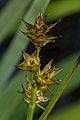
- Stems with one single terminal spike
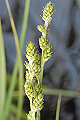
- Multiple spikes on stems, spikes with both male and female flowers
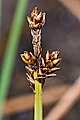
- spikes condensed at the top
- spikes more evenly spaced along the stem
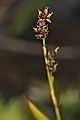
- Multiple spikes with distinctly different male/female spikes
- female flowers with 3 styles
- female flowers with 2 styles
Carex species: Stems having only one terminal spike
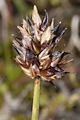
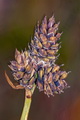
Carex species: multiple spiked stems: spikes not distincly male or female, Spikes condensed at the top of flowering stems.
Carex species: multiple spiked stems: spikes not distincly male or female, Spikes more or less evenly spaced along flowering stems.
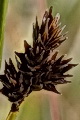
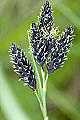
Carex species: multiple spiked stems: spikes clearly divided in mainly female-flowered and mainly male-flowered types;
female flowers 3 styled.
(a) species with drooping female spikes
(b) species with upright female spikes
Carex species: multiple spiked stems: spikes clearly divided in mainly female-flowered and mainly male-flowered types;
female flowers 2 styled.
Monocotyledons: Grasses
For most people, even nature lovers, grasses do not bring great enthousiasm. This is even more so when it concerns identification of grass species. To difficult, it is believed. That though is exaggerated. One needs to know the names of typical morphological elements of grasses. If you are not sure, check this.
The inflorescences of grasses are often divided in three classes, being:
- loose / slightly contracted panicles
- spike like panicles
- spikes
By far the most species belong to the loose/ slightly contracted panicles group.
To quickly sieve through all grasses one can first settle the inflorescence type. If it belongs to the first group one can check the number of flowers in the spikelets and in case of many if the spikelets are somewhat flattened. Further identification is then not so difficult anymore.
Finally this section is yet far from complete but does include nearly all common grass species of Iceland. I am planning to introduce many more species in the future.
Panicles with spikelets having just one flower
Panicles with spikelets having two - thee flowers
Panicles with spikelets having many flowers
Panicles with spikelets having few - many flowers: Poa species: these have rather flattened (keeled) spikelets.
Spike-like panicles: Alopecurus and Phleum species
Spike-like panicles: other species
True spikes
Water plants
Members of the Potamogetonaceae are all true waterplants
The following water plants are close relatives of the Plantain-family
Miscellaneous other water plants.